
Driveways, patios & pool decks in Alachua County
Concrete Contractors in Gainesville, FL
Concrete built on a solid base and sloped for Florida downpours, with every price written down before work starts.
- Free on-site measuring visit
- Written, itemized quote for every job
- Base, drainage and thickness spelled out before we pour
Concrete Built for Gainesville Rain and Sand
Gainesville Concrete Contractors builds and repairs driveways, patios, walkways, pool decks, stamped surfaces and slabs for homeowners in Gainesville, Florida, and the towns around it in Alachua County. Concrete contractors in Gainesville work in a different climate from most of the country. Wikipedia's climate table for the city shows January lows that average about 43 degrees, so frost damage is rare. The real tests are heat, heavy rain and soft ground. July highs average 91 degrees, and the city gets about 48 inches of rain a year, with June the wettest month at more than 7 inches.
What breaks concrete around here
Water under the slab. A summer storm can drop more water in an hour than the ground can take in. If runoff from a roof, a downspout or a neighbor's yard flows under a driveway or patio, it carries sand away, and the slab cracks and settles into the gap.
Sand over limestone. Alachua County's sinkhole fact sheet says sinkholes are most common in the western and central parts of the county, where limestone is exposed or covered by less than 25 feet of sand. The same sheet notes that ground often sinks after heavy rain, especially after a dry spell, and that leaking pipes, buried debris and runoff from roofs and pavement can cause it too. Most cracked slabs are not sitting on sinkholes. But the soil here moves when water moves through it, and a slab has to be built for that.
Roots. Older neighborhoods have big oaks, and their roots lift walks and driveway edges.
Heat on pour day. In summer, fresh concrete can dry too fast at the surface. That leads to weak tops and shrinkage cracks unless the crew plans the pour for it.
How we build against it
- Remove soft, organic or loose soil and compact the base in layers, so the slab is supported evenly from edge to edge
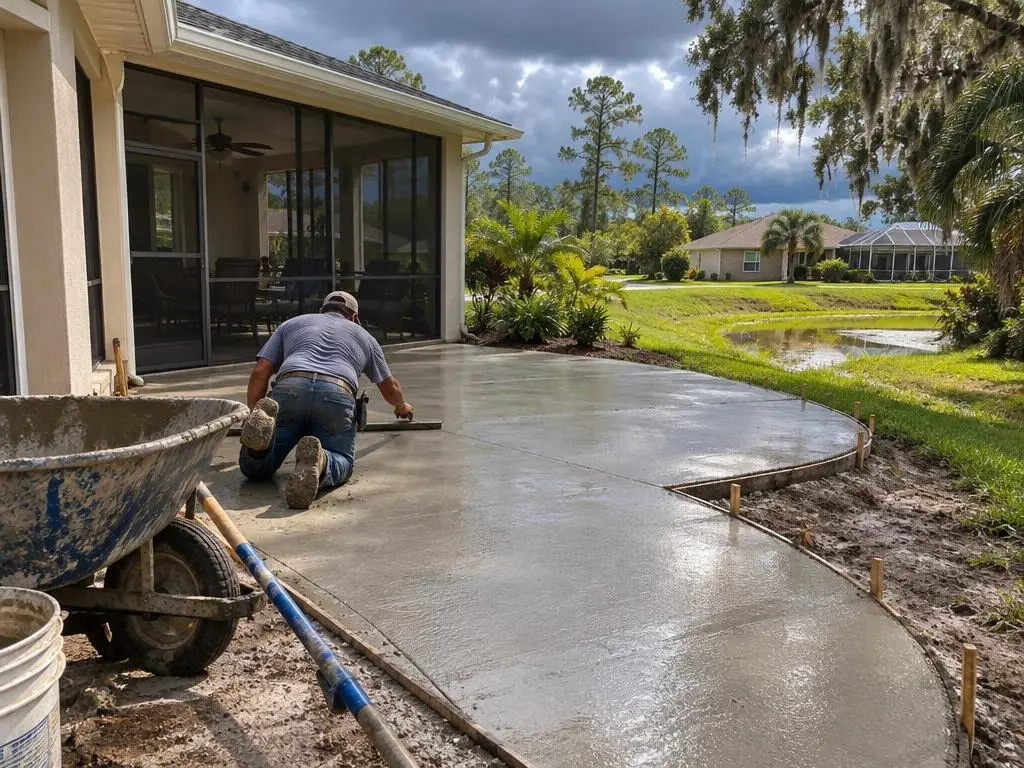
- Slope every slab so water runs off and away from the house, pool and garage door
- Extend or reroute downspouts that empty against concrete
- Match thickness to the load, from about 4 inches for a patio up to 6 inches where the City of Gainesville requires it for a driveway in the right-of-way
- Cut control joints on a planned layout so shrinkage cracks run where we want them
- Pour early in the day in summer, keep the base damp and cure the surface so it does not dry out too fast
Gainesville homes and their concrete
Point2Homes, summarizing Census data, puts the median build year for Gainesville housing at 1983. About 40 percent of homes were built in the 1970s and 1980s, and another 10 percent in the 1960s. That means many driveways, carport slabs and back patios in the city are 35 to 55 years old. Original concrete from that era was often poured thin on whatever sand was there, so settled panels, cracked aprons and patios that tilt toward the house are common calls for us.
The city's oldest areas are older still. Wikipedia lists the Northeast and Southeast Gainesville residential districts and the Pleasant Street Historic District on the National Register, with many Victorian and Queen Anne homes from the 1880s and 1890s. On those streets, walks and steps often have to be fit around big trees, porches and old foundations.
Driveway rules in the city
In Gainesville, driveway installation is permitted and inspected through the Department of Sustainable Development (352-334-5050), according to the city's Public Works right-of-way page. The part of the driveway between your property line and the street has to meet the city's design standards. Public Works memo EDCM 24-02 (October 2024) says driveways in the right-of-way are built of 6-inch-thick concrete, that the apron grade should not be steeper than 9 percent without the City Engineer's approval, and that single-family homes on minor local streets may use the city's concrete flared driveway detail. Outside city limits, Alachua County Public Works handles right-of-way connection permits. We check which rules apply to your address and plan the apron to fit them.
Six services
- Concrete driveways: replacements, widening, new aprons and extra parking pads.
- Patios and walkways: back patios, lanai extensions, front walks and garden paths.
- Pool decks: new decks, extensions and textured surfaces that stay cooler and grip when wet.
- Stamped and decorative concrete: stone, slate and brick patterns, color, and exposed aggregate.
- Slabs and pads: garage and carport floors, shed pads, and pads for AC units and generators.
- Repair and leveling: lifting sunken panels, resurfacing worn concrete, sealing cracks and replacing broken sections.
When to pour
Concrete can be poured here most of the year, which is one advantage of North Central Florida. Summer is the hardest season. Afternoon storms can roll in on pour day, and high heat cuts the time a crew has to finish the surface. We schedule summer pours for the morning, watch the radar and keep covers on hand. Spring and fall are easier, and winter pours are fine on most days. Call (352) 558-2464 and we will set a time to measure.
Our Concrete Services
Driveways, patios, pool decks, stamped work, slabs and repairs, each built on a solid base and sloped for Gainesville rain.
Concrete Driveways
New and replacement driveways on a compacted base, sloped to shed storm water, with aprons built to city or county standards.
Learn more →Concrete Patios & Walkways
Back patios, lanai extensions, front walks and garden paths, sloped so summer storms drain away from the house.
Learn more →Pool Decks
New pool decks, deck extensions and textured surfaces that grip when wet and stay cooler underfoot.
Learn more →Stamped & Decorative Concrete
Stone, slate and brick patterns, integral color and exposed aggregate for patios, entries, walks and pool decks.
Learn more →Concrete Slabs & Pads
Garage and carport floors, shed pads and equipment pads, built level on a compacted base and sized for what sits on them.
Learn more →Concrete Repair & Leveling
Lifting sunken slabs, sealing cracks, resurfacing worn concrete and replacing sections that cannot be saved.
Learn more →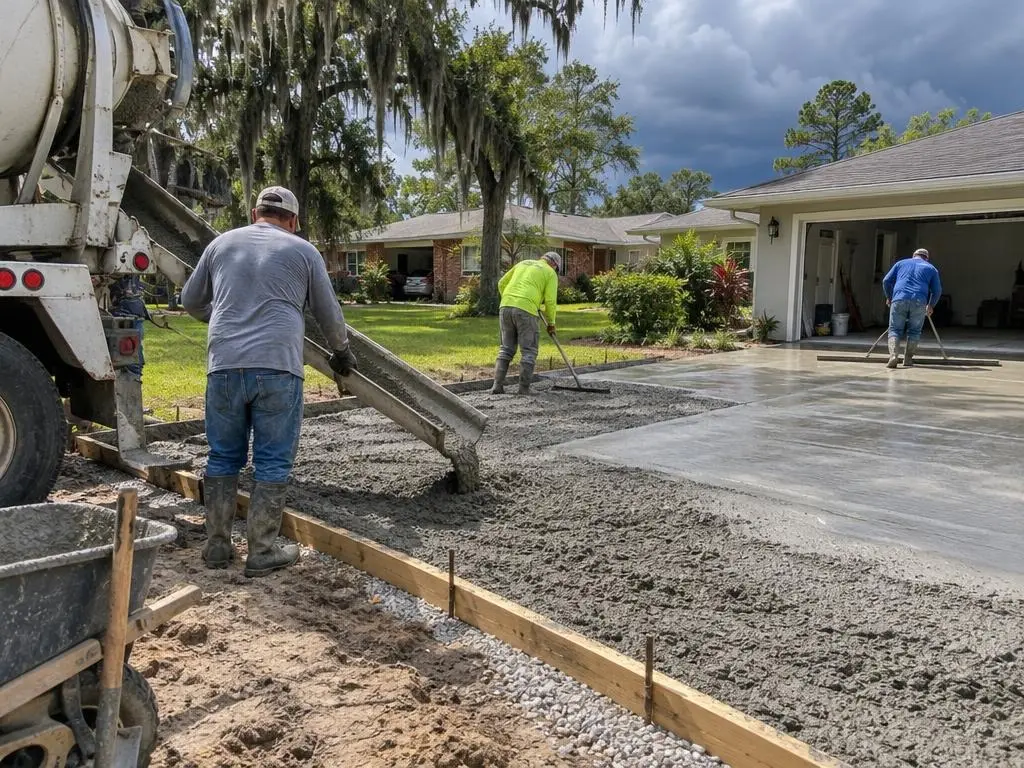
Common Questions
What should I look for in residential concrete contractors in Gainesville?
Get two or three written bids and compare more than the total. Each bid should state slab thickness, how the base will be prepared, reinforcement, joint layout, finish and who gets the permit. Ask how the contractor will handle drainage and any downspouts near the slab. A contractor who can explain why your old concrete failed is more likely to build the new slab right.
How do I choose between Gainesville concrete companies?
Ask each one the same questions: how deep they dig, what they compact under the slab, how thick the concrete will be and how water will drain. Ask whether the quote includes removal and hauling. Ask how they plan summer pours around heat and afternoon storms. Clear, specific answers are a good sign.
What does a concrete driveway cost in Gainesville?
HomeGuide's national cost guide lists standard concrete driveways at $6 to $10 per square foot installed, and $2,400 to $6,000 for a 20 by 20 foot two-car driveway. Removing an old driveway adds $2 to $6 per square foot. Gainesville prices can be higher or lower, so the written estimate after we measure is the real number.
Do I need a permit for a driveway in Gainesville?
Yes. The City of Gainesville's Public Works page says driveway installation and driveway inspections go through the Department of Sustainable Development, 352-334-5050. Outside the city, Alachua County Public Works issues right-of-way connection permits. We confirm what your address needs and build it into the schedule.
Why does concrete crack and sink in Gainesville?
Usually it is water moving sand out from under the slab. Downspouts, heavy summer storms and poor slope are the common causes, and roots lift slabs in older neighborhoods. Alachua County's sinkhole fact sheet also lists leaking pipes, decaying buried debris and runoff from roofs and pavement as causes of ground sinking.
Could the cracks in my driveway be a sinkhole?
Most cracks are not. But Alachua County's fact sheet lists cracks in pavement and rain pooling where it never pooled before among the warning signs. If the ground near your home is dropping or you see other signs, the county says a licensed geologist or qualified engineer should evaluate it before any concrete is replaced.
Can concrete be poured in Gainesville summers?
Yes. We pour in the morning, keep the base damp so it does not pull water from the mix, and cure the surface so it does not dry too fast. If storms are coming, we move the pour.
When can I drive on a new driveway?
HomeGuide's driveway guide says foot traffic is usually fine after 24 to 48 hours, cars after at least 7 days and heavy vehicles after the full 30-day cure. We give you dates for your slab in writing.
Why Homeowners Call Gainesville Concrete Contractors
Base and drainage first
Soft sand removed, the base compacted, and every slab sloped so storm water runs off and away.
Itemized written quotes
Removal, base, thickness, reinforcement, finish and sealing on separate lines.
Repair quoted when it works
Leveling or resurfacing priced next to replacement when the slab can be saved.
City and county rules checked
Aprons planned to Gainesville or Alachua County right-of-way standards before we pour.
Where We Work
Most of our work is in Gainesville itself, from the older neighborhoods around downtown and the University of Florida to the ranch-home subdivisions on the east and northwest sides. We also work in the nearby towns of Alachua and High Springs to the northwest, Newberry and Archer to the west, Micanopy to the south past Paynes Prairie, Hawthorne to the east and Waldo to the northeast, along with Haile Plantation and Jonesville just west of the city. Rules change at the city line. Inside Gainesville, driveways go through the city's Department of Sustainable Development. In unincorporated Alachua County, right-of-way connections go through County Public Works, and each small town has its own office. Each town page covers what we found about local homes, soil and permits.
- Concrete Contractors in Gainesville, FL
- Concrete Contractors in Alachua, FL
- Concrete Contractors in Newberry, FL
- Concrete Contractors in High Springs, FL
- Concrete Contractors in Archer, FL
- Concrete Contractors in Hawthorne, FL
- Concrete Contractors in Micanopy, FL
- Concrete Contractors in Waldo, FL
- Concrete Contractors in LaCrosse, FL
- Concrete Contractors in Haile Plantation, FL
- Concrete Contractors in Jonesville, FL
- Concrete Contractors in Melrose, FL
- Concrete Contractors in Williston, FL
- Concrete Contractors in Starke, FL
- Concrete Contractors in Keystone Heights, FL
- Concrete Contractors in Cross Creek, FL
- Concrete Contractors in Trenton, FL
- Concrete Contractors in Bronson, FL
- Concrete Contractors in McIntosh, FL
- Concrete Contractors in Fort White, FL
- Concrete Contractors in Evinston, FL
- Concrete Contractors in Bell, FL
- Concrete Contractors in Brooker, FL
- Concrete Contractors in Hampton, FL
Get a Free Concrete Estimate in Gainesville
We measure on site and give you a written price, anywhere in Gainesville and nearby Alachua County towns.